This is a slightly unusual write-up, as it conflates
two trips to Sussex in search of Holmes’ retirement cottage. Holmes took early
retirement in 1903, and moved to a house on the South Downs, where he kept
bees. We have only two cases recorded by Watson during this time, ‘The Lion’s Mane’
and ‘His Last
Bow’, with the former providing much of the information about his
cottage and surrounding area, in a tale recounting his investigation of an
unusual murder.
I had first visited the area in August 2010, managing
to reach both the cottage identified as being Holmes’s and the nearby school, The
Gables, as well as the beach where the main action of ‘The Lion’s Mane’
takes place.
However, having identified some additional points of
interest, having spent the last couple of days on the Kent/Sussex
border, I made my way fuller into East Sussex. Catching a train from East
Croydon, and changing at Lewes (where I had to wait for almost half-an-hour due
to my in-bound train running five minutes late meaning that I just missed my
connection), and catching a train to Seaford, the true identity of ‘Fulworth’
in 'The Lion's Mane'. The first stop was Newhaven Town, which would have
been the station that Holmes and Watson alighted at to catch the Dieppe ferry
in ‘The Final
Problem’, having changed trains at Canterbury on learning that
Professor Moriarty was pursuing their original train. As it had begun raining
heavily, I managed to get from photos from inside the train, without having to
step onto the platform.


Around ten minutes later and the train was pulling
into Seaford Station. From here it was a three minute walk to Seaford Police
Station, where Holmes sends Mathematics teacher Ian Murdoch, colleague of
the murdered Fitzroy McPherson, to report the murder.
“You can hurry to the police-station at
Fulworth. Report the matter at once”- Sherlock
Holmes [LION]
Another short walk brought me to the junction of
Steyne Road and Cricketfield Road. It was here that ‘The Haven’, the home of
Maud Bellamy, who was in a relationship with the murdered man, (and her father
and brother) lived. The original building had a square tower, separate from the
house although joined to it, and in the same cream-rendered and black-timbered
construction as the rest of the house. It was one of three identical houses
erected in Cricketfield Road in the late 1890s by Charles Morling, described as
'the best builder in Seaford'. However, the tower has since been removed, a
garage added in front and, as with many Victorian houses, the original slates
replaced with cheaper tiles.
“That’s The Haven, as
Bellamy called it. The one with the corner tower and slate roof. Not bad for a
man who started with nothing but by Jove, look at that !” - Stackhurst [LION]
I then walked for about
ten minutes to catch a #12 bus, initially alighting at Gayles Farm on the A259,
with the intention of walking along to access the possible candidates for
Holmes’ retirement cottage and The Gables that I had visited fourteen
years before. However, the rain had increased and there proved to be no
pavement for walking the ½ mile to the site, with a steady stream of vehicles
speeding along the A-road. I, therefore, waited at the stop for ten minutes,
catching the next #12 into the nearby village of East Dean.
-------------------------------------------------------------------------------------------------------------------------------------------
At this point, I shall
outline my experiences from fourteen years before in which I accessed the
buildings from another direction in sunny weather. On this occasion, I also
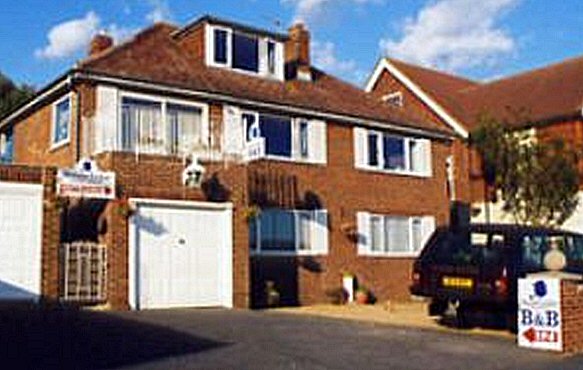
arrived at Seaford by train, making a brief detour to Holmes Lodge, a
local guest house (unfortunately now
closed).
I then caught a #12 bus to the Exceat Park Centre,
where just behind the bicycle hire shop, there was a gate, which led down to a
pasture and old flint wall with steps over it. Walking down here, I crossed the
wall and made my way down a long flight of wooden steps to the village of
Westdean with a small pond. Following the gravel road eastwards, after ¾ mile,
I reached my first port of call, a house and converted barn named New Barn, and
just past it Newbarn Cottage, a semi-detached pair of cottages knocked
into one by bricking up the right-hand door.
This cottage stands
fractionally over five miles from the centre of Eastbourne, making it a prime
candidate for Holmes' retirement home, as in the first few pages of ‘His
Last Bow’, the unidentified narrator states that Holmes retired to “a
small farm upon the Downs, five miles from Eastbourne”. Watson’s
literary agent, Conan Doyle, knew the area well, having been born in
Crowborough, and was said to have been a regular visitor to the Eastbourne area
during the later years of his life.
The flint cottages made a
compact single house of eight rooms, while the high-pitched double roof
bespeaks a large attic, suitable for Holmes' chemistry experiments. Behind the
house at the foot of a steep slope is a paddock where Holmes could have had his
bee-hives, as sheltered a spot as you could wish for. The cottage lies deep in
Newbarn Bottom, facing south-east, marooned in grassy slopes as far as the eye
can see. Whether standing near it or viewing it from afar, the sense of being
cut off from the outside world is palpable and profound. Though the busy
Brighton Road is not far, no traffic can be heard. In its emptiness and
silence, the place is the epitome of loneliness.
From the paddock a track
previously wound up over Newbarn Hill to the brow beyond, over 350ft above
sea-level, which Holmes could have walked until a whole swathe of the Channel
hoved into view. A short distance away is Cliff End, the 'great cliff'
described in 'The Lion's Mane'.
“My villa is situated upon the southern
slope of the downs, commanding a great view of the Channel. - Sherlock Holmes [LION]
Next I made my way over
the hill, to Gayles Retreat,
a substantial property in its own grounds reached by a long drive. This
represents the prime candidate for Stackhurst’s school, The Gables. The
house was built in 1900, and while some additions and alterations have been
made over the years, the building is much as it was. More recent buildings,
both agricultural and residential, are now scattered around, but in 1907 the
house stood quite alone. It would therefore have been an ideal property for
Stackhurst to have leased for his “crammers”. The stroll to Holmes' cottage is
the required half-a-mile north-west over the hill, and the stroll to Cliff End
for the swimmers is just over a mile. The Gables is also a reasonable
renaming of Gayles by Holmes in his account, following his old friend Watson's
habit of slightly tweaking the names of buildings. At the time I visited it was
holiday accommodation, but the building is now used as a Yoga retreat.
_Friston%20%20%5BLION%5D.JPG)
I then made my way past a
prominent red-roofed barn, getting a good view of the village of East Dean,
until I reached a stile near the car park in Birling Gap. From here I made my
way along an undulating coastal park until I found myself at Cliff Edge,
the prime candidate for the site of the cliffs overlooking the beach where the
Lion’s Mane attack took place. The height of Cliff End above the beach is
around 150 feet, but around its western corner, the bluff shelves away to a
steep grass-covered bank about 80 feet high, with multiple scramble paths, such
as the one that features in the story.
“At this point the
coast-line is entirely of chalk cliffs, which can only be descended by a
single, long, tortuous path, which is steep and slippery” - Sherlock Holmes [LION]
I therefore made my way
down one of these paths to Cuckmere Haven Beach below. The fatal bathing
pool must have been somewhere in front of the ‘great cliff, and at the time of
the McPherson incident would have been relatively new. It had only been
‘discovered’ a few years earlier, because up to 1900 it had been difficult to
reach. Then the River Cuckmere meandered due east across the estuary, made a
sharp right-angled turn, and flowed into the sea at Cliff End, hugging the
cliffs so closely that it was a hazardous climb down to the beach. However,
around 1900, the river found a new outlet nearer the Seaford shore, and the old
river bed was left as a long, muddy lagoon, which dried out, but also regularly
refilled with water. I therefore made my way there, taking photos of where the
attack on McPherson took place, the general beach and some fishing boats out at
sea.
“Towards the end of July,
1907, there was a severe gale, the wind blowing up-channel, heaping the seas to
the base of the cliffs and leaving a lagoon at the turn of the tide” – Sherlock
Holmes [LION]
“On the sea two or three
fishing-boats were at no great distance” – Sherlock Holmes [LION]
I
then caught a bus back to central Seaford, catching a train home.
-------------------------------------------------------------------------------------------------------------------------------------------
Back in the present, having alighted from the bus in
East Dean, I made my way up a side road until I reached The Green, and the War
Memorial which looks like a very old village cross and was built after World
War I. The railings were hand-made by the last village blacksmith. However, it
was to New House Farm, a house directly behind the Memorial that I was
heading. This house, which currently acts as the Gilbert Estate Office (the
Davies-Gilbert family developed East Dean and Eastbourne in the 19th Century),
has a blue plaque which states that this is where Sherlock Holmes retired to.
Although not having such a strong claim as the cottages that I had visited
fourteen years before, Charles O. Merriman, a former chairman of the Sherlock
Holmes Society of London suggested that this house was a plausible location for
Holmes’ retirement. I therefore took multiple photos of the property, including
a bee-hive in the back garden.
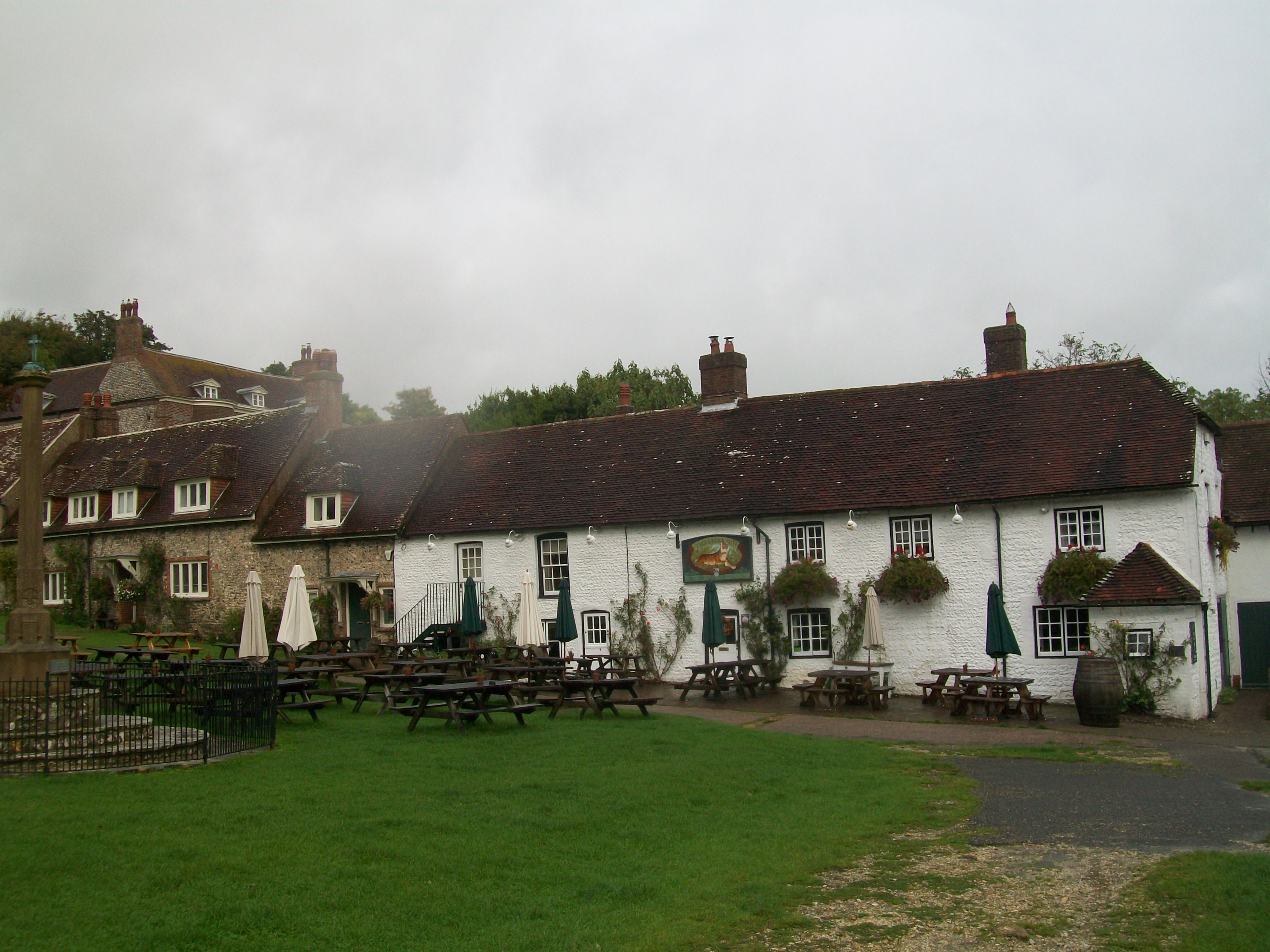
I then made my way back
across the Green to The Tiger Inn, whose name probably comes from the Manor’s coat
of arms which is a leopard, but as both date back to the 15th century, neither
had been seen in this country and so it remains a bit of a mystery. The Inn had
a reputation in the world of smugglers & also ‘wreckers’ who used to lure
unsuspecting ships onto the rocks with lamps. After pilfering their cargo the
‘wreckers’ would throw the crew back into the treacherous waters. The three
adjoining cottages were used as barracks during the Napoleonic wars. I popped
into the pub for a large Coke and to get out of the steadily increasing rain.
Making my way back to the bus stop, I caught the next bus
into Eastbourne Town Centre, getting some lunch and browsing the shops. I then
made my way to Eastbourne Station, catching a train to Polegate. From here I
caught a taxi to my final destination, Knockhatch
Adventure Park, home to ‘The Sherlock Holmes Experience’, an interactive walk-through adventure,
in which participants navigate through twisting Victorian streets, using their
powers of deduction to find hidden clues, licenced by the Conan Doyle Estate.
Arriving at just after
3.30pm, admission prices were at a reduced rate, so I paid and entered, finding
my way to the Experience immediately. On arrival, it seemed that the attraction
is only open for fifty-minute periods at certain times during the day, with the
last session having begun twenty minutes before. I therefore made my way into
the attraction, watching an introductory video from a bearded
Holmes (Jon Campling),
before making my way through two giant rollers into the attraction itself.
There were five picture clues to find, the initials of
which (recorded in the SHE online notebook) revealed which canonical
character – the choices were Moriarty, Moran and Adler – was responsible for
the theft of a golden locket. [Watching online videos of others going round, it
seems that the clues are regularly changed to give different culprits]. Although there were no live actors, there were
plenty of ‘jump scares’ from sudden bangs to jets of air being released. I
wandered round, happily taking photos (which I later saw from the rules that I
bypassed was not allowed) and solving the case. The SH content was limited and
it could just as much have been a ‘Jack the Ripper’ attraction. The experience
ended outside a 221b door (I was a little disappointed that it wasn’t the
sitting room) with my deductions proved correct, and Holmes anachronistically
speaking about hashtags.


Outside I took a few
photos of the entrance, then a member of staff took pity of my trying to take a
selfie with a photo of ‘bearded Holmes’, and offered to take it for me.
I then wandered over to
the Lost World Playbarn, which seemed to be themed around the second
‘Jurassic Park’ film rather than the Conan Doyle
novel.
Making my way into the
gift shop (which had lots of Dinosaur merchandise, but no Sherlock Holmes
themed items), I called for a taxi back to Polegate, which turned out to be the
same driver. I was in plenty of time for my train back, from Polegate to East
Croydon, and then home.








_Police_Station_1%20%5BLION%5D.JPG)
_Police_Station_2%20%5BLION%5D.JPG)
_Police_Station_5%20%5BLION%5D.JPG)
_1%20%5BLION%5D.JPG)
_2%20%5BLION%5D.JPG)
_3%20%5BLION%5D.JPG)

_Seaford_2%20%5BLION%5D.JPG)
_Seaford_1%20%5BLION%5D.JPG)
_Friston%20%20%5BLION%5D.JPG)


_East_Dean_1%20%5BLION%5D.JPG)
_East_Dean_2%20%5BLION%5D.JPG)
_East_Dean_4%20%5BLION%5D.JPG)
_East_Dean_5%20%5BLION%5D.JPG)
_East_Dean_6%20%5BLION%5D.JPG)